
The Geopolitical Architecture Behind the U.S. and Israeli Attack on Iran
By Shardad Khabir
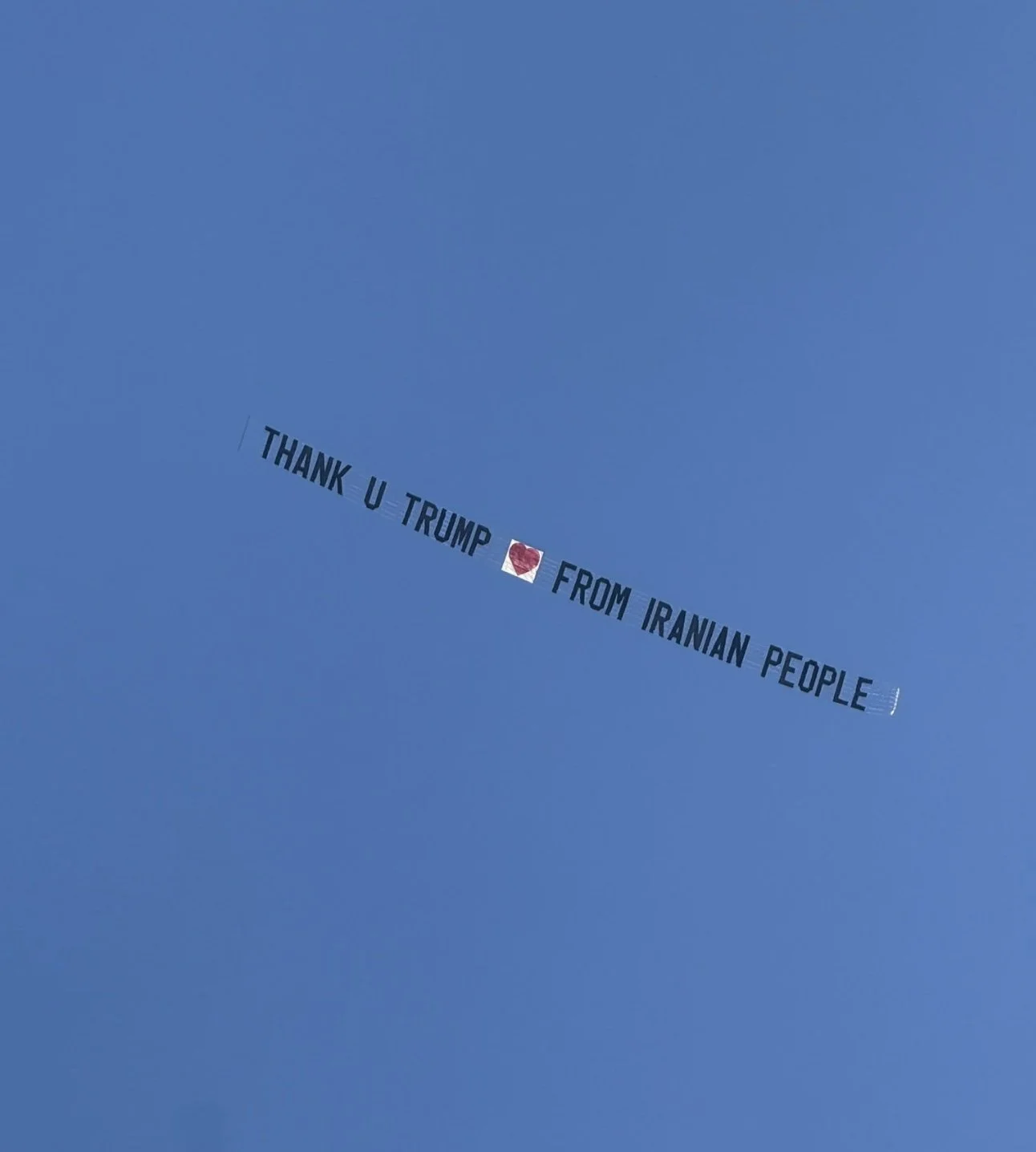
Facebook post by David Harris: Flying Over the City of Los Angeles
The Roots of a Manufactured Regime
The Islamic Republic did not emerge solely from internal revolutionary forces but from a geopolitical design shaped by globalist powers. In this view, Britain played the central role, supported by France, Germany, and the United States, in constructing a clerical regime that could restrain Iran’s national independence and keep the region fragmented. The goal, as understood by many Iranians who hold this interpretation, was to impose a system that would be predictable, controllable, and useful for foreign interests.
From the very beginning, the Iranian people resisted clerical regime and attempted to challenge the new order in the early 1980s. These efforts were met with severe repression, but also were undermined by the international powers that had a stake in the regime’s survival.
Forty‑Seven Years of Resistance and Suppression
For nearly half a century, Iranians have lived under a system they did not choose and have repeatedly attempted to overthrow. Major uprisings—1999, 2009, 2017, 2019, and 2022—reflect a population unwilling to accept authoritarian rule. Yet each movement was crushed.
Supporters of this interpretation argue that the Islamic Republic survived not because of internal legitimacy but because its foreign architects continued to strengthen it. They point to several patterns:
The regime’s proxies created controlled instability across the Middle East.
Neighboring states purchased weapons in response to Iran’s growing power.
Western governments alternated between sanctions and engagement, reinforcing the regime’s position.
A democratic Iran would have disrupted the geopolitical balance that benefited global powers.
In this view, the Iranian people have endured 47 years of imposed rule, repeatedly denied the chance to determine their own future.
A Strategic Split Between the U.S. and the U.K.
A major turning point came with the election of Donald Trump. Shortly after, the U.S. and the U.K.—long aligned on Middle Eastern policy— began to diverge sharply because of the following reasons:
The U.K. has been undergoing internal ideological and demographic shifts, moving toward a more Islamic‑aligned foreign policy.
This shift included a cooling of support for Israel and a growing alignment with forces seeking to weaken or eliminate the Israeli state.
The Islamic Republic became a tool for this new British strategy, enabling pressure on Israel and reshaping regional power dynamics.
This divergence created a fracture within the Western alliance, setting the stage for a new geopolitical confrontation.
Trump’s Strategic Reorientation Toward Iran
President Trump recognized that the old Western approach to Iran—engineered by the U.K. and Europe—no longer served American interests. His administration viewed Iran not only as a threat but also as a potential future partner if removed from the influence of globalist networks.
Trump’s strategy included:
Countering Russia and China by pulling Iran out of their geopolitical orbit.
Reducing European influence in the Middle East.
Reasserting U.S. dominance by reshaping alliances.
Ending the globalist model that used Iran as a destabilizing proxy.
This was not simply about nuclear weapons or terrorism. It was about redefining the entire strategic map of Eurasia and the Middle East.
Why the U.S. and Israel Moved Toward Military Action
The U.S. and Israeli attack on Iran are the culmination of several converging forces:
The Islamic Republic’s expanding regional power and proxy networks.
Its pursuit of nuclear capability.
The U.K.’s shift toward policies increasingly hostile to Israel.
The need for the U.S. to break the globalist architecture that had protected the regime.
The long‑term strategic value of eventually integrating Iran as a U.S. partner.
Therefore, this recent attack on February 28, 2026 was not an isolated event but the result of decades of geopolitical engineering, shifting alliances, and the unraveling of a system built in 1979.
The Iranian People at the Center of the Crisis
The greatest tragedy is that the Iranian people — who have resisted this regime for 47 years — have been trapped between foreign agendas, regional conflicts, and global power struggles. Their struggle for freedom has been overshadowed by the interests of states that either built the regime, benefited from its existence, or sought to reshape it for their own strategic goals.
According to this narrative, the recent military confrontation is not the beginning of a new chapter but the long‑delayed collapse of a geopolitical project imposed on a nation that never accepted it.